



Outbreaks, Recalls, and Investigations
Following is a list of selected outbreaks, recalls, and investigations with wide impact in Wisconsin.
As of October 2, 2026, the Wisconsin Department of Health Services (DHS) has confirmed 243 cases of measles in Wisconsin so far in 2026.
Grant, Iowa, Lafayette, and Vernon Counties (Southwest Wisconsin) measles outbreak
As of October 2, 2026, there have been 220 confirmed and 6 probable cases in the outbreak in Grant, Iowa, Lafayette, and Vernon Counties.
The ongoing investigation indicates that measles is spreading locally. DHS, in coordination with Grant, Iowa, Lafayette, and Vernon County Health Departments, are working to identify and notify people who may have been exposed to the measles virus.
Northern Wisconsin measles cases
Marathon County
As of October 2, 2026, there have been 5 confirmed case of measles reported in Marathon County.
These cases are related to out of state travel and are not related to the cases in Southwest Wisconsin. Marathon County Health Department and DHS are working to identify and notify people who may have been exposed to the measles virus.
Chippewa County
As of October 2, 2026, there has been 10 confirmed case of measles reported in Chippewa County.
This case is related to out of state travel and is not related to the cases in Southwest Wisconsin. Chippewa County Health Department and DHS are working to identify and notify people who may have been exposed to the measles virus.
What is a confirmed case?
Confirmed measles cases are cases that have symptoms consistent with measles and have been laboratory confirmed or have a direct link to a confirmed case by location and time. Probable cases have symptoms consistent with measles but have not been laboratory confirmed or directly linked to a confirmed case.
Understanding changes in reported measles cases
The number of newly reported measles cases may vary over the course of an outbreak. A decrease in reported cases does not necessarily mean that measles spread has slowed or stopped at this time.
When an outbreak is first identified, public health agencies focus on active case finding in order to understand who is affected, how the outbreak is spreading, and who may be most at risk. During this phase, it is expected that there will be a rapid increase in confirmed and probable cases.
After this initial phase, cases are then primarily identified when people seek medical care and their providers report suspected or confirmed cases to public health agencies.
In any outbreak, the number of confirmed cases may not represent the true number of infections, because not everyone gets tested, needs medical care, or contacts public health agencies. Current case counts could reflect differences in how cases are being identified rather than a true decrease in measles activity.
Public health agencies continue to monitor reports of illness, conduct enhanced surveillance in outbreak areas, and work closely with health care and community health partners. Additionally, public health agencies continue working to help people protect themselves and prevent additional measles cases by providing access to vaccines and monitoring for any potential public exposures to measles.
What should Wisconsinites do?
Those who are most at risk are those who are not vaccinated or don’t know their vaccination status. If you believe you have been exposed to measles and are not immune, remain at home and monitor for symptoms.
DHS urges all people to check their vaccination status, as vaccination against measles is the best way to prevent measles illness.
What is measles?
Measles is a highly contagious, serious disease caused by a virus. The virus can be spread through the air and through direct contact with people who are infected. Measles can cause serious health complications, including pneumonia, brain damage, and deafness, and can sometimes be deadly. One in four people who get measles in the United States will be hospitalized.
Unvaccinated young children and other non-immune adults are at highest risk of serious disease from measles.
For a full description of measles, see:
- DHS measles fact sheet, P-42174 (available in English, Hmong, Somali, and Spanish)
- DHS measles webpage
- CDC measles webpage
What are the symptoms of measles?
Anyone who was exposed to measles would expect symptoms to start 10 to 21 days after exposure. Symptoms include:
- Runny nose
- High fever (may be greater than 104 F)
- Tiredness
- Cough
- Red, watery eyes, or conjunctivitis (pink eye)
- A red rash with raised bumps that starts at the hairline and moves to the arms and legs three to five days after symptoms begin
If you develop any symptoms of measles, stay home (do not go to work, school, shopping, or use public transportation) and call your doctor’s office or clinic before visiting so they can take precautions so that other patients are not exposed to the virus.
How to get vaccinated
The best way to prevent measles is to get vaccinated with the Measles, Mumps, Rubella (MMR) vaccine. Two doses of MMR vaccine are about 97% effective at preventing measles; one dose is about 93% effective. In general, people born before 1957 are considered immune and do not need a vaccine. All other adults without laboratory evidence of immunity should have at least one dose of measles-containing vaccine, and children should have two doses. Find more information about who should get a measles vaccine on the DHS measles webpage.
If you, or your family, need to get vaccinated contact your health care provider to schedule an appointment. People with health insurance may have vaccine benefits through a pharmacy as well—check your policy. Local health departments may be able to provide MMR vaccine to uninsured adults through the Vaccines for Adults (VFA) program. The Wisconsin Vaccines for Children Program (VFC) covers the cost of vaccines for eligible children. Check the VFA and VFC webpages for a provider near you.
How to check your vaccination status
Wisconsin residents can find their immunization records using the Wisconsin Immunization Registry (WIR). Instructions can be found in the DHS fact sheet Wisconsin Immunization Registry Information for Parents, P-42154 (available in English, Spanish, and Hmong). If you are unable to access your records, please contact your doctor’s office or your local health department.
Wastewater monitoring for measles in Wisconsin
Wastewater results are one tool used alongside other public health data to help monitor for the presence, and potential spread, of viruses like measles. The Wisconsin Wastewater Monitoring Program tests untreated wastewater in communities across the state for measles. This includes 44 permanent sites (testing since June 2025), and four temporary sites established in Iowa, Lafayette, and Grant counties in response to the current outbreak.
Wastewater detections for participating wastewater treatment facilities that serve a population of 3,000 or more will be shared publicly on the CDC’s National Wastewater Surveillance System Dashboard.
Summary of wastewater results
Measles virus has been detected in wastewater samples from the following counties during the current measles outbreak. Due to ongoing measles activity in Wisconsin, continued detections of measles in wastewater from these areas is expected.
- Iowa County: Detected in samples from 8/26/2026 and 8/31/2026
- Grant County: Detected in a sample from 8/19/2026, 9/2/2026, and 9/7/2026
- Lafayette County: Detected in a sample from 8/25/2026
- Green County: Detected in a sample from 9/16/2026
- All other sites in Wisconsin: No recent detections
What do these results mean?
When measles is detected in wastewater from a community, it means that one or more people infected with measles was present in the community around the time the sample was collected. Wastewater treatment facilities can represent both the city and the surrounding areas, as well as people who may travel in and out of the area for activities such as work, school, or health care. Someone who does not live in a community could therefore be represented in wastewater while they are there.
Learn more
DHS’s Wastewater Monitoring Program and Wisconsin dashboards for COVID-19, flu, and RSV are available on the Wisconsin Wastewater Monitoring Program webpage.
The Wisconsin Department of Health Services is working with local, state, and federal partners to investigate a Salmonella outbreak linked to pet turtles.
- According to the CDC (Centers for Disease Control and Prevention), 20 people in 12 states have become infected with the outbreak strains of Salmonella. Five people have been hospitalized.
- Half of the sick people are children younger than 5 years old.
- Wisconsin has one laboratory confirmed case linked to this outbreak.
Turtles and Salmonella
Pet turtles can carry germs like Salmonella in their droppings even if they look clean and healthy. You can get sick from touching a turtle or touching areas where they live and roam and then touching your mouth or food with unwashed hands.
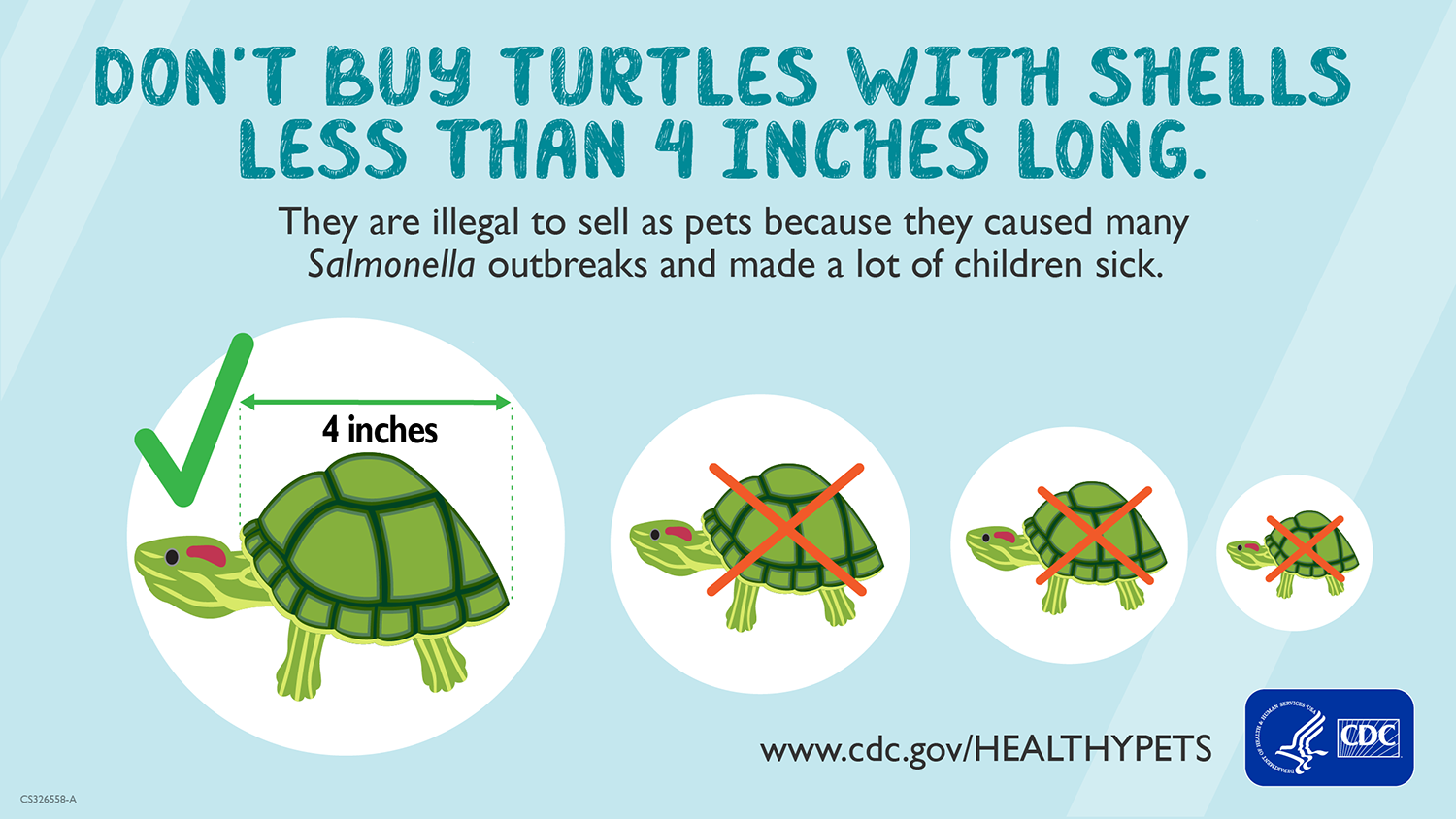
A federal law bans the sale and distribution of turtles with shells less than 4 inches long as pets due to them causing many illnesses, especially in young children. However, they are still sold illegally online, at stores, flea markets, and roadside stands.
What you should do
If you are thinking of getting a pet turtle:
- Only buy turtles with shells longer than 4 inches from a reputable pet store.
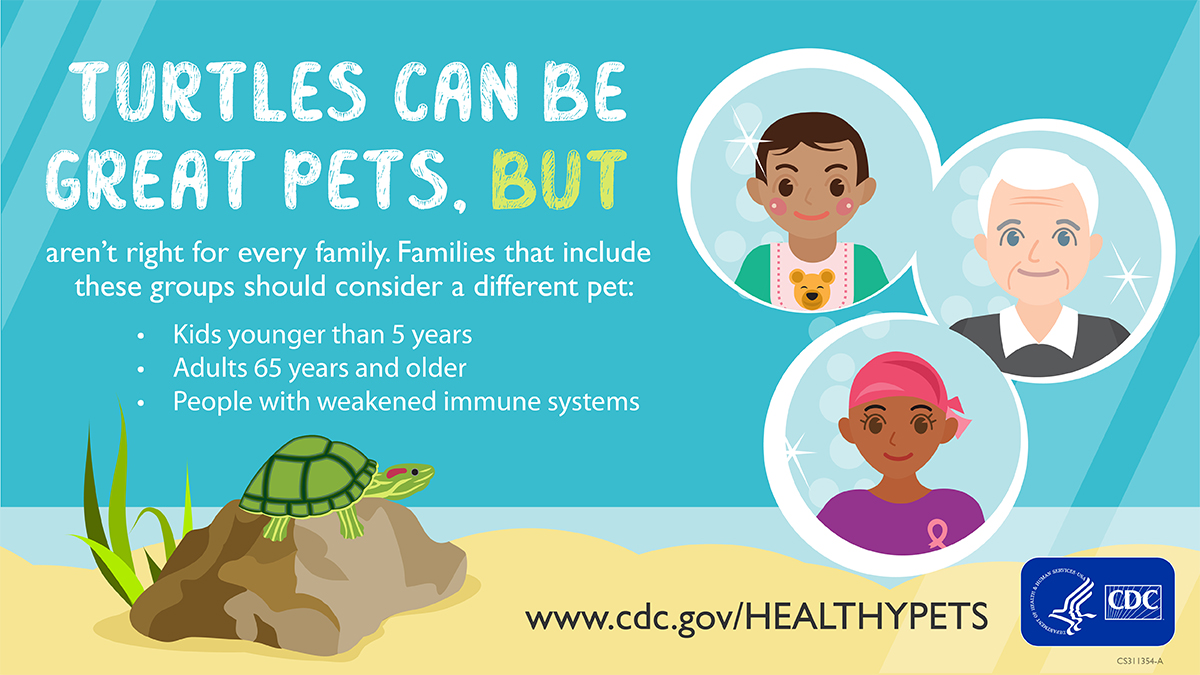
- Pet turtles are not recommended for certain groups including: children younger than 5, adults aged 65 and older, and people with weakened immune systems. These groups are more likely to get a serious illness from germs that turtles can carry.
Make sure to always take these steps to keep you and others healthy:
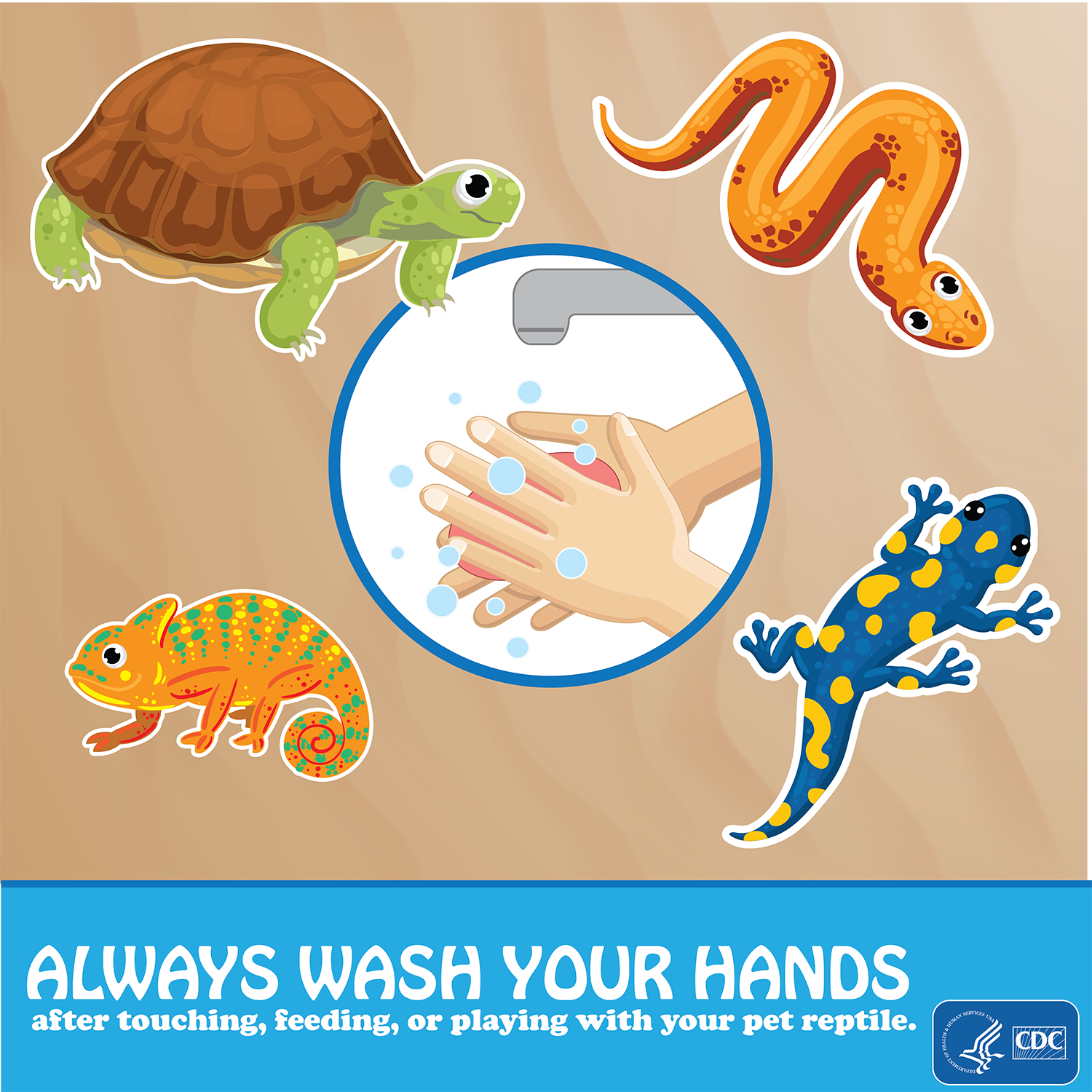
- Wash your hands with soap and water:
- After touching or feeding your turtle.
- After touching or cleaning the area where your turtle lives and roams.
- Play safely
- Don't kiss or snuggles your turtle and don't eat or drink around it.
- Parents and caregivers of young children should consider taking additional precautions like changing shirts between holding pets and infants.
- Don't cross-contaminate
- Have a dedicated enclosure for your turtle. Do not let it roam where young children crawl and play.
- Keep your turtle and its equipment out of the kitchen or anywhere food is prepared, stored, served, or eaten.
- When cleaning your turtle's supplies:
- Clean supplies outside the house, if possible.
- If you must clean the supplies indoors, don't clean them in the kitchen or other areas where food is prepared and eaten. Use a laundry sink or bathtub.
- Pour any water from your turtle's enclosure down the toilet instead of sinks or drains.
- Call your health care provider for any severe signs of Salmonella:
- Diarrhea and a fever higher than 102°F
- Diarrhea for more than two days that is not improving
- Bloody diarrhea
- So much vomiting you cannot keep liquids down
- Signs of dehydration, such as:
- Not peeing much
- Dry mouth and throat
- Feeling dizzy when standing up
What businesses should do
- Do not sell or distribute turtles with shells less than 4 inches long. A federal law bans the sale and distribution of these turtles as pets.
- Educate customers on how to stay healthy around turtles.
- Display stickers by turtle areas and give a copy to customers that purchase turtles:
Symptoms of Salmonella
Diarrhea, fever, and stomach cramps are the most common symptoms of Salmonella.
- Symptoms usually start six hours to six days after swallowing the germ.
- Most people recover in four to seven days, without treatment.
- Some groups, like children younger than 5 years, adults 65 years and older, and people with weakened immune systems, may experience more severe illnesses and that require medical treatment and hospitalization.
Resources
As of August 26, there have been 284 cases of cyclosporiasis reported in Wisconsin during this year's Cyclospora season so far, including eight hospitalizations.
One hundred eighty-one of the confirmed cases did not report traveling outside the United States during the 14 days prior to symptoms starting and are domestically-acquired infections.
DHS encourages people to stay up to date on recalls that impact Wisconsin on the U.S. Food and Drug Administration's website.
Learn more about Cyclospora on the cyclosporiasis webpage.
Advice to consumers
Follow food and vegetable handling recommendations:
- Wash your hands, utensils, and food preparation surfaces before and after handling and preparing raw produce.
- Rinse all fruits and vegetables thoroughly under running water before eating, cutting, or cooking. Use a clean produce brush to scrub firmer produce.
- Cut away any damaged or bruised areas on produce before preparing and eating.
- Refrigerate cut, peeled, or cooked fruits and vegetables as soon as possible or within two hours.
- Cook produce when appropriate.
Resources
See the Food and Drug Administration (FDA) and Centers for Disease Control and Prevention (CDC) webpages for more information and to stay up to date on other food-borne outbreaks and recalls:
The Wisconsin Department of Health Services (DHS) is working with Minnesota health officials, the Centers for Disease Control and Prevention (CDC), U.S. Food and Drug Administration (FDA), and other states to investigate an outbreak of Shiga toxin-producing E. coli (STEC) and Salmonella infections linked to alfalfa sprouts.
- According to the CDC, 55 people in 15 states have become sick with one of the outbreak strains of E. coli and/or Salmonella. Four people have become hospitalized and no deaths have occurred.
- Seventeen Wisconsinites have become sick with one person hospitalized.
Recall information
The illnesses have been linked to alfalfa sprouts produced by Everything Sprouts sold under the Calco and Everything Sprouts brands. The alfalfa sprouts were distributed to restaurants and grocery stores. See the FDA's original recall notice for detailed lot and recall information: Everything Sprouts, LLC Recalls Alfalfa Sprouts Due to Potential E. Coli and Salmonella Risk.
Everything Sprouts also recalled certain lots of Robust Radish Sprout Mix distributed to wholesale distributers and grocery stores. See the FDA's recall notice for detailed lot and recall information: Everything Sprouts, LLC Expands Voluntarily Recall to Include Robust Radish Mix Due to Potential E. Coli and Salmonella Risk.
What you should do
- Check your home for alfalfa sprouts from Calco and Everything Sprouts Brand.
- Do not eat them and throw them away.
- Wash items and surfaces that may have touched the affected sprouts using hot soapy water.
- Call your health care provider for any severe symptoms:
- Diarrhea and a fever higher than 102°F
- Diarrhea for more than two days that is not improving
- Bloody diarrhea
- So much vomiting you cannot keep liquids down
- Signs of dehydration, such as:
- Not peeing much
- Dry mouth and throat
- Feeling dizzy when standing up
What businesses should do
- Do not sell or serve alfalfa sprouts grown by Everything Sprouts.
- Wash and sanitize surfaces that may have come into contact with the affected sprouts.
Symptoms of Salmonella
Diarrhea, fever, and stomach cramps are the most common symptoms of Salmonella.
- Symptoms usually start six hours to six days after swallowing the germ.
- Most people recover in four to seven days, without treatment.
- Some groups, like children younger than 5 years, adults 65 years and older, and people with weakened immune systems, may experience more severe illnesses and that require medical treatment and hospitalization.
Symptoms of Shiga toxin-producing E. coli (STEC)
Stomach cramps and diarrhea, often with bloody stools, with a low-grade or no fever are the most common symptoms of STEC.
- Symptoms usually start two to five days after swallowing the germ.
- Most people recover in five to seven days.
- STEC infections can lead to hemolytic uremic syndrome (HUS), a severe complication that involves acute kidney failure and other severe problems.
Resources
- CDC: About Escherichia coli infection
- CDC: About Salmonella infection
- FDA: Everything Sprouts, LLC Recalls Alfalfa Sprouts Due to Potential E. Coli and Salmonella Risk
- FDA: Everything Sprouts, LLC Expands Voluntarily Recall to Include Robust Radish Mix Due to Potential E. Coli and Salmonella Risk
- CDC: E. coli and Salmonella Outbreak Linked to Alfalfa Sprouts
The Wisconsin Department of Health Services is working with local, state, and federal partners to investigate a multistate outbreak of Salmonella linked to jalapeño peppers.
- According to the CDC (Centers for Disease Control and Prevention), as of August 19, 431 people in 32 states have become sick with the outbreak strain of Salmonella (Salmonella Javiana). Fifty-seven people have become hospitalized and no deaths have occurred.
- Wisconsin has 12 laboratory confirmed cases linked to this outbreak. No hospitalizations in Wisconsin cases have been reported.
The affected jalapeño peppers were distributed to Chipotle Mexican Grill and Qdoba. Both establishments have removed the product from their stores after learning of the outbreak. CDC and the U.S. FDA (Food and Drug Administration) do not consider there to be any ongoing risk to consumers from these establishments in this outbreak.
Recall information
Jalapeño peppers
- Distributed by Coast Citrus Distributions
- Grown in Sinaloa, Mexico
On August 9, Taylor Fresh Foods recalled several products containing jalapeños. See the Taylor Fresh Foods jalapeño recall notice from the FDA for a full list of products. Two products were sold in Wisconsin at Walmart stores:
- Freshness Guaranteed Hot (or Spicy) Pico De Gallo 10 oz.
- UPC: 681131276351
- Best if used by date: 8/08/2026 - 8/16/2026
- Freshness Guaranteed Mild Pico De Gallo 10 oz.
- UPC: 681131276344
- Best if used by date: 8/08/2026 - 8/16/2026
On August 12, Whole Foods Market recalled several products from its Produce and Prepared Foods department that contain jalapeños. The recalled products were sold in Wisconsin and have Best Before/Best By Dates of 8/7/2026–8/16/2026. See the Whole Foods jalapeño recall notice from the FDA for a full list of products.
Advice for consumers
- Do not eat recalled jalapeño peppers or products made with recalled peppers. Throw them away or return them to where you bought them
- Wash items and surfaces that may have touched the recalled products with hot soapy water or a dishwasher.
- Call your health care provider for any severe signs of Salmonella:
- Diarrhea and a fever higher than 102°F
- Diarrhea for more than three days that is not improving
- Bloody diarrhea
- So much vomiting you cannot keep liquids down
- Signs of dehydration, such as:
- Not peeing much
- Dry mouth and throat
- Feeling dizzy when standing up
Advice for businesses
- Do not sell or serve recalled jalapeño peppers or products made with recalled peppers.
- Wash and sanitize items and surfaces that may have come into contact with the recalled jalapeño peppers.
- More information for businesses can be found on the FDA's outbreak investigation of Salmonella-Jalapeños advisory.
Symptoms of Salmonella
Diarrhea, fever, and stomach cramps are the most common symptoms of Salmonella.
- Symptoms usually start six hours to six days after swallowing the germ.
- Most people recover in four to seven days, without treatment.
- Some groups, like children younger than 5 years, adults 65 years and older, and people with weakened immune systems, may experience more severe illnesses and that require medical treatment and hospitalization.
Resources
- FDA: Taylor Fresh Foods Recalls Products Made with Jalapeno Peppers Because of Possible Health Risk
- FDA: Whole Foods Market Announces a Recall of Select Salsas, Guacamole, Pico de Gallo, and Prepared Foods Products Because of Possible Health Risk
- CDC: Salmonella Outbreak Linked to Jalapeños
- FDA: Outbreak Investigation of Salmonella–Jalapeños
- CDC: About Salmonella infections
To view previous outbreaks and investigations, visit our Past Outbreaks in Wisconsin page.